
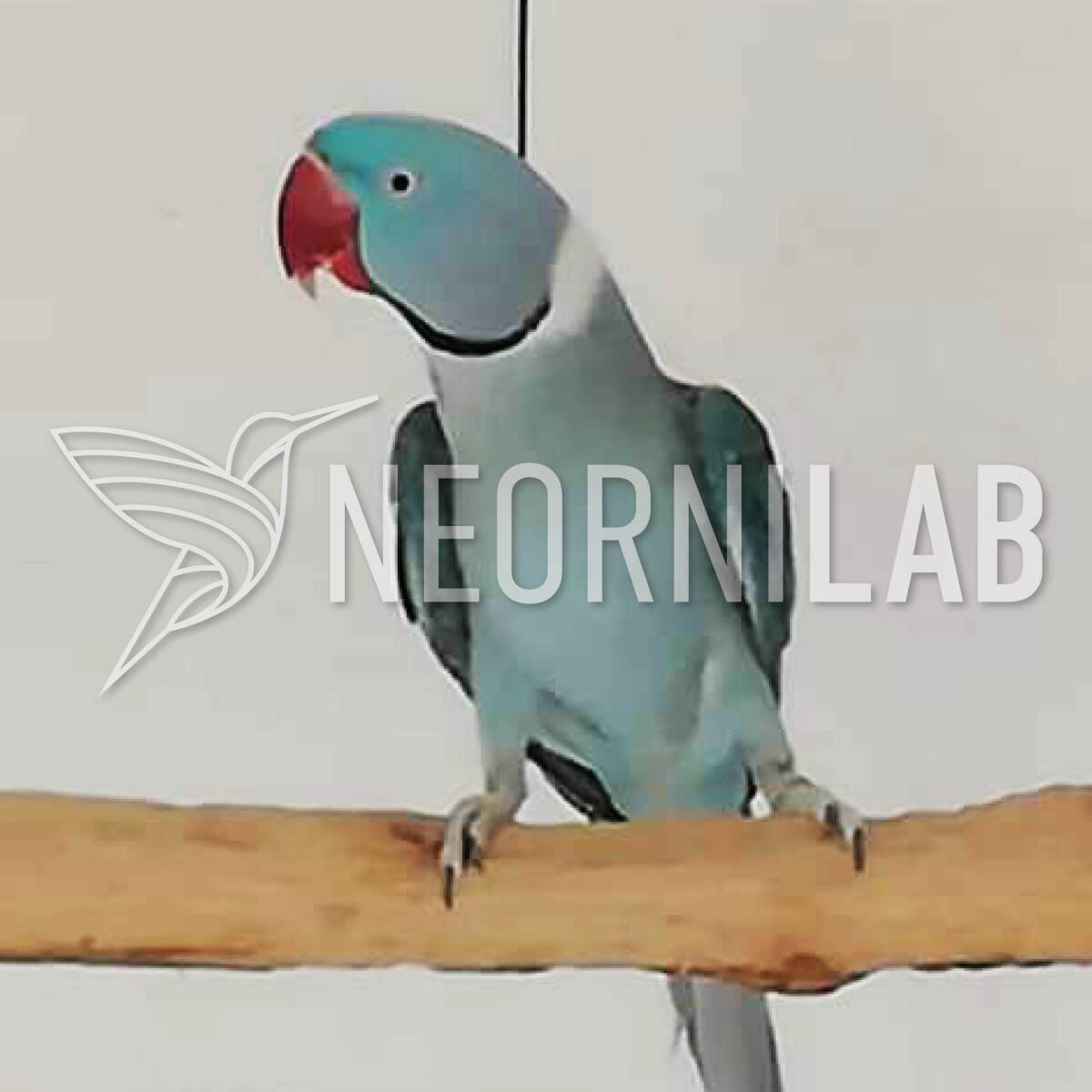
Psittacula eupatria: the blue-parblue (Aqua) mystery
24/04/2026
Blue, Parblue, Aqua, Turquoise. Four phenotypes, one genetic family in the Alexandrine Parakeet, and three mutations that make the difference.
Psittacula eupatria: the blue-parblue (Aqua) mystery
Blue, Parblue, Aqua, Turquoise: four phenotypes, one genetic family. In the Alexandrine Parakeet (Psittacula eupatria) we know three blue mutations that together explain these colour shades. But how exactly does that work?
In this article we set out what we have confirmed in our laboratory to date, and we introduce the targeted DNA analyses (colloquially "split testing") that let you, as a breeder, distinguish between these mutations.
Why do we test genotype, not colour?
Two birds that look visually identical can be genetically completely different. At NeorniLab we therefore do not test for the colour, but for the specific genotypic variation (colloquially "mutation") that causes the colour.
In some species, including the Alexandrine Parakeet, several independent mutations exist that can lead to the same phenotype. Phenotypically you cannot tell the difference. Genotypically you can.

How blue and green arise
In parrots (Psittaciformes), psittacofulvin is produced, a yellow to red pigment that is deposited in the plumage. Combined with the blue structural colour of the feathers (a physical effect, not a pigment), this produces the classic green wild colour: yellow pigment over a blue structure = green.
A blue mutation causes a disruption in the enzyme that produces psittacofulvin. We distinguish two types here. A complete deactivation of the enzyme, Total Psittacine Reduction (TPR), leads to the yellow pigment disappearing entirely and produces a true blue mutation. A partial deactivation, Partial Psittacine Reduction (PPR), produces intermediate colours such as Aqua or Turquoise, often called Parblue. How the end result looks also depends on the natural wild-type colour, the presence of eumelanin and the feather structure.
A blue Alexandrine Parakeet is therefore a bird in which this enzyme is completely switched off (TPR).

What is blue3 and why does it cause Aqua?
Blue3 is the mutation colloquially known as "Aqua", and the one that causes the most misunderstanding. We discovered blue3 when we analysed Alexandrine Parakeets with the Parblue phenotype, the birds that breeders colloquially call "Aqua" or "Aqua blue".
A terminological footnote.
The term "Parblue" is an umbrella term for all the blue intermediate colours between green and full blue. The term therefore holds across species, but which genetic variations fall under it does differ per species. In the Eclectus parrot (Eclectus roratus) the Parblue phenotype arises in birds with the blue1/blue2 genotype. In the Alexandrine Parakeet the Parblue phenotype arises in birds with the blue2/blue3 genotype, and in everyday use the term "Aqua" is more often applied. The phenotypic term therefore travels between species, the genetics does not.
The analysed birds with a Parblue phenotype turned out to carry only blue2. So there had to be a second mutation that explained the almost complete loss of psittacofulvin. That is how we arrived at blue3.
All the references submitted trace back genetically to one single combination: blue2/blue3, compound heterozygous. Phenotypically all of these birds look identical. The term "Aquablauw" reflects precisely the underlying genetics: Aqua is only visible in combination with a blue variant. Breeders often use "Aqua" and "Aquablauw" interchangeably for exactly this genotype.
Wat extra nuance.
Blue3 is a recessive mutation that only becomes apparent when it is combined with another mutation on the same gene (blue1 or blue2). Two copies of blue3 alone (blue3/blue3) presumably just give a green bird. Phenotypically, Aqua is therefore often described as "incompletely dominant", because it becomes apparent in combination with another Blue variant. On the dominance scale from wild type to Blue, Aqua sits just above it. Both framings are correct: genetically blue3 is recessive, phenotypically Aqua behaves, in combinations with other Blue variants, as incompletely dominant.

Blue1/blue3: Turquoise? And blue3/blue3: Green?
To date we have tested one Alexandrine Parakeet that turned out to be genotypically blue1/blue3, and that visually gave a more Turquoise phenotype. A single observation is not yet confirmation. Whether this pattern recurs consistently will have to be shown by further research.
Blue3/blue3 we have not yet picked up so far. Our current assumption is that a homozygous blue3 bird simply looks Green phenotypically, which would explain why we do not find them in our database. Further research will have to confirm this.
Do you have a pair in which both parents carry blue3?
We are open to mapping out those lines further. You may send us samples of such pairs and their offspring free of charge.
What do blue4 and blue5 mean in the Alexandrine Parakeet?
The genetic variations blue4 and blue5 we have not yet picked up in the Alexandrine Parakeet. They have, however, been recorded in the Rose-ringed Parakeet (Psittacula krameri), where they probably originally arose and where they are referred to as the blue1 and blue2 mutations.
When we do find blue4 or blue5 in a bloodline kept as an Alexandrine Parakeet, that is a genetic signal of hybridisation. This may have happened in captivity or in the wild. You can read more about this in our blog post on species purity between Psittacula eupatria and Psittacula krameri.

What this gives you as a breeder
A targeted DNA screening for blue1, blue2 and blue3 puts your breeding planning on solid ground.
In concrete terms:
- You test only what is relevant for your bloodline. No unnecessary analyses for mutations that are not present.
- You put pairs together with a predictable result. You know in advance what percentage of the young will have which phenotype, instead of guessing breeding season after breeding season. That saves time as well as unnecessary splits in your aviary.
- You prevent inbreeding. By knowing which birds are possibly split for a given mutation, you can out-cross deliberately to wild-colour birds. This keeps genetic diversity in your bloodline without losing the desired colour varieties.
- You give your buyers certainty. Every tested bird receives a unique NeorniLab certificate that you pass on at the point of sale. Buyers can verify the certificate at purchase via our certificate checker. Conversely, when buying a bird yourself, you can have the seller's genetic claim confirmed.